
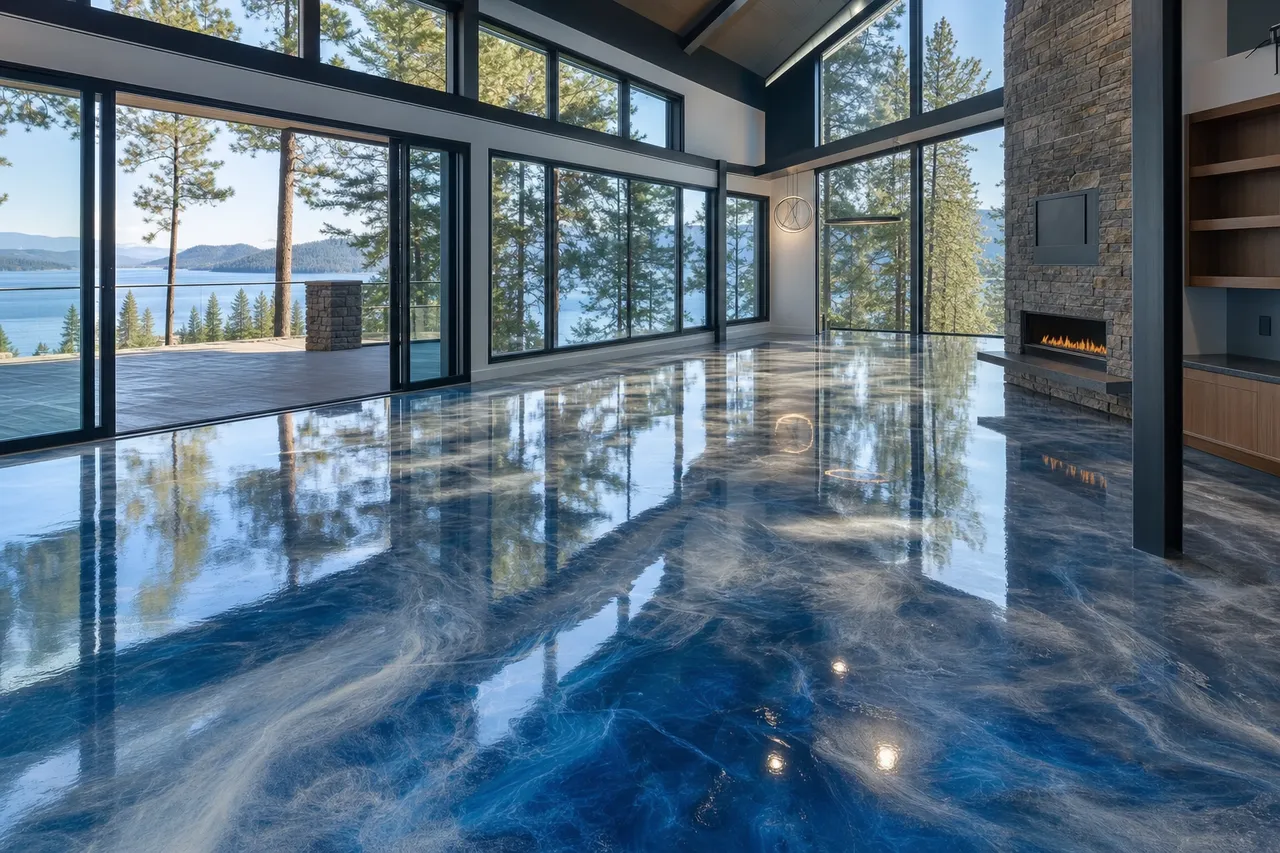
Metallic · interior · basement
Metallic epoxy floors in Coeur d'Alene, Idaho
A floor that moves like water under a window wall, poured in the great room that looks at the lake, or the lower level that walks out to it. Metallic pigment worked by hand into clear epoxy, sealed under a top coat that never ambers, over a slab that was metered before anyone said yes.
What it is
Metallic pigment in clear epoxy, moved while it is live
A metallic floor is a 100% solids clear epoxy with a mica-based metallic pigment stirred through it, poured over a pigmented base coat and then worked. The installer moves the wet epoxy with a roller and a light solvent mist while it is still live, and the pigment pools and separates into the marbled swirl. The floor sets that way. Then an aliphatic clear top coat locks it, with a grit additive wherever feet will be wet.
No two square feet are the same, which is the reason you will not be handed a chip. Samples for metallic are poured boards, a foot or two across, so you can see how a color pairing actually moves before it is on your floor. Bring one to the room at the hour the sun comes through the windows; the floor will look like that, not like the showroom.
- Two-tone and three-tone pours, or a single metallic over a dark base for a quieter floor
- Grit in the top coat at entries, baths and the walk-out door, matte or satin where gloss is too much
- Solid color or quartz-broadcast alternatives when metallic is more floor than the room wants
Where it goes here
The rooms that ask for it in Kootenai County
Lake-view great rooms
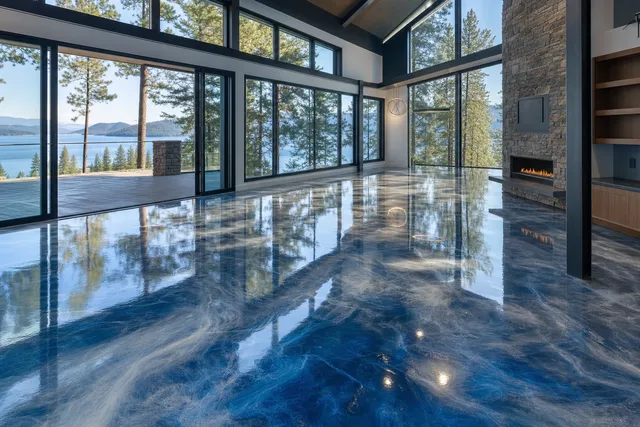
The window wall on Lake Coeur d'Alene or Hayden Lake is the reason to do it: the floor takes the sky and the water and hands them back. Blue-and-silver and charcoal-and-pewter pours are the ones that hold up next to that view without fighting it.
Walk-out lower levels
Half the houses on the lakes are cut into a hillside, with the lower level walking out to the shore. That is the room most likely to want a metallic floor and the slab most likely to be wet. It gets the moisture test before it gets a sample board.
Finished basements on the Prairie
New construction from Post Falls to Rathdrum finishes the basement a year or two after move-in. A sealed epoxy floor there is warm to look at and mops in a minute, and the slab is young enough that the meter reading matters twice. Where the pour falls among the framers, the drywall crew and the trim carpenter is laid out in the guide to the floor in a basement finish.
Showrooms and salons
A metallic floor is a piece of the room a customer remembers. Salons, boutiques, a dealership showroom in the Silver Lake Mall corridor: one pour, textured where the chairs roll and the wet feet walk, and the commercial spec underneath it.
The basement rule
A Kootenai County basement slab is never as dry as it looks
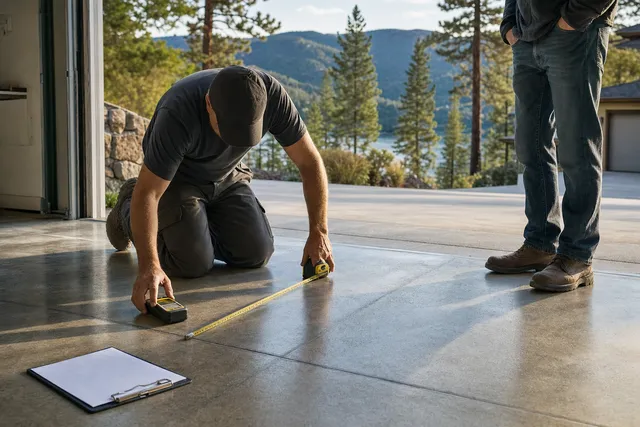
Snowmelt and spring rain sit in the ground here for months, and water vapor drives up through a basement slab that feels bone dry to your hand. Roll epoxy over it and the vapor has nowhere to go; a year later the floor has blisters, and what is inside them is the reason the room smelled damp. Every interior slab the pros this site connects you with take on gets a calcium chloride test or an in-slab relative humidity probe first, and the number goes on the estimate.
Pass, and the floor goes in as planned. Fail by a little, and a moisture-mitigation primer adds $1.50 - $3 per sq ft and lets the coating breathe against it. Fail by a lot, on a walk-out cut into a wet hillside with water coming through the cove joint, and the honest answer is no coating this year, said before you have spent anything. A basement in this county that has never been tested is not a basement you should coat.
Lower level or great room? Say which, and the estimate comes back in writing.
Rough square footage, whether the room is finished and lived in, and what the slab does in April. That is enough to hear a range by system before anyone brings a sample board.
Inside an occupied house
How an interior pour actually goes
A garage can be coated with the door open. A great room cannot, so an interior floor is scheduled around the people living over it. Grinding runs on dust extraction and the room is sealed from the rest of the house. 100% solids epoxy has little odor compared with the solvent-thinned kits, but the pigment mist and the top coat do off-gas, and the house is ventilated through the cure. The floor is walkable the next day and takes furniture after the cure window written into the estimate, which is a few days longer in a cool lower level than in a warm room upstairs.
Window walls change one thing in the spec. Epoxy itself ambers where sun hits it every afternoon, so the clear top coat over a metallic floor is always an aliphatic one that does not. Ask what top coat is on the estimate. If the answer is a plain epoxy clear, the swirl by the west window will be yellow by the second summer.
Before the crew arrives
- The room emptied to the walls, baseboards off or masked
- Pets and plants elsewhere for the pour and the first day of cure
- The sample board approved in the room's own light
- The moisture reading on the estimate, not in someone's memory
Too much floor for the room? Solid-color epoxy at $5 - $7.50 per square foot, or a quartz broadcast where feet are always wet, use the same prep and the same top coat. The garage floor page covers the flake systems.
Asked around Kootenai County
Metallic and basement questions, answered plainly
How much does a metallic epoxy floor cost in Coeur d'Alene?
Metallic runs $11 - $16 per square foot installed in Kootenai County, with diamond grinding, the metallic base, and the UV-stable top coat included. It sits above a flake floor because the base coat is thicker, the pigment is worked by hand, and the top coat has to be the clear, non-yellowing kind. Small rooms carry a $1,200 minimum. If the slab fails its moisture test, a mitigation primer adds $1.50 - $3 per sq ft and goes on the written estimate before anything is scheduled.
What are the disadvantages of a metallic epoxy floor?
Four honest ones. It shows every roller and trowel move the installer made, which is the whole look until it is a mistake you cannot unsee. It is slick when wet unless a grit additive goes in the top coat, so entries and bathrooms get texture whether the sample board had it or not. It cannot be spot-repaired invisibly, because no two square feet match and a patch never swirls into the old floor. And it is not a kit floor: the pigment has to be moved while the epoxy is live, by someone who has done it before.
How long do metallic epoxy floors last?
Fifteen to twenty years indoors when the slab was tested, the epoxy is 100% solids, and the top coat is an aliphatic clear that does not amber. The metallic layer itself never wears; the top coat does, and it can be scuffed and re-cleared when it goes dull. A floor rolled over an unmetered basement slab lasts until the first wet spring, whatever the pigment cost.
Is it a good idea to epoxy a basement floor?
Only after the slab passes a moisture test. A finished basement or walk-out lower level in Kootenai County sits on ground that is wet from snowmelt half the year, and vapor drives up through concrete you would swear was dry. Tested and passing, epoxy is the best basement floor there is: sealed, warm to look at, mopped in a minute. Tested and failing, the answer is a mitigation primer or a plain no, and the pros this site connects you with will say which.
Can mold grow under an epoxy floor?
Not under a bonded coating on a slab that tested dry; there is nothing between the epoxy and the concrete for it to live in. It grows under a coating that trapped moisture, which is what happens when someone rolls a basement without metering it first. The blister that lifts a year later is the vapor, and what is in the blister is the mold. The test is the whole point.
Deciding whether a coated floor is the right floor at all? The honest downsides guide says when to leave a slab alone, and the pricing page puts every system side by side by the square foot.
Written estimates, by system
Tell us about the room. The estimate comes back in writing.
Which room, roughly how many square feet, and whether the slab has ever been tested. That is enough to place it in a range, and the meter turns the range into a written number by system. Prefer the phone? Call (208) 758-9728.
- Itemized on paper - the grind, the repairs, the system, the top coat
- Slab moisture and temperature checked before anyone promises a date
- Cold-season work quoted as the system that can actually cure, never a guess