
Patios · porches · pool decks · steps
Exterior concrete coatings in Coeur d'Alene, Idaho
The concrete outside the house has the hardest job on the property: it freezes forty nights a winter, gets salted, and sits in full lake sun all summer. A coating that lives out there has to be built for exactly that, and the ones that were not are the ones flaking off the front steps every March.
Why outdoor concrete fails here
Freeze, thaw, salt, repeat
Bare concrete is a sponge with a hard face. Rain and snowmelt soak into the top quarter inch, the temperature drops below freezing overnight, the water expands, and a thin layer of the surface lifts off. Do that forty or fifty times between November and March and you get the pitted, flaking slab most of Kootenai County recognizes on its own front steps. De-icer makes it faster: the salt keeps pulling water in and lets it refreeze at lower temperatures, so the apron by the garage door and the walk you salt every morning are always the first to go.
A coating or a sealer stops the water at the surface, and the damage stops with it. Which one belongs on which slab is the whole conversation below, because a film that is right on a covered patio is wrong on a driveway under a plow blade.
- Patios, covered porches and pool decks: a UV-stable coating with slip texture
- Front steps, stoops and garage aprons: coated or sealed, depending on wear
- Driveways and walks under studded tires and shovels: a penetrating sealer, not a film
The exterior systems
Four honest answers for outdoor concrete
Coating · patios, porches, pool decks
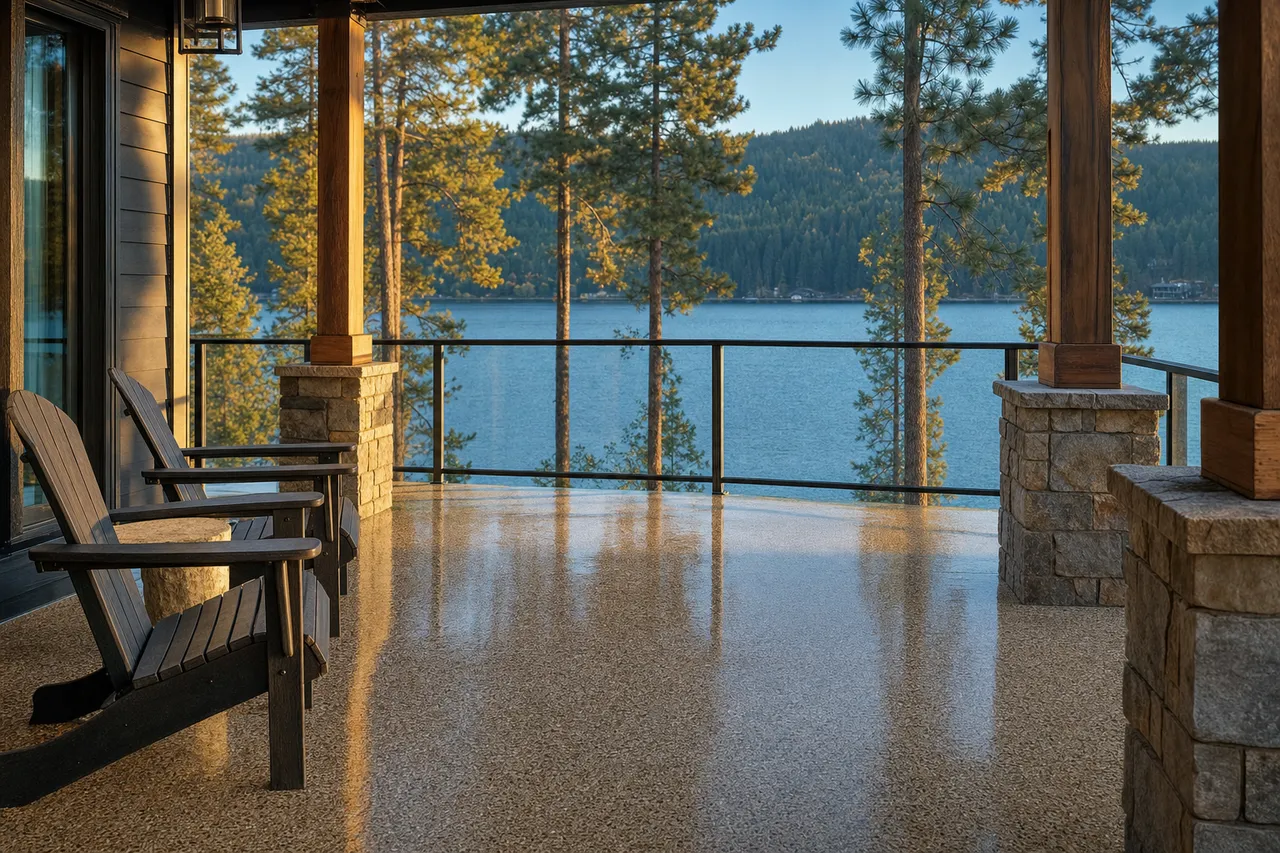
A ground slab, repaired, primed, and coated with an aliphatic polyaspartic or polyurea system that holds its color in full sun and flexes through freeze-thaw instead of cracking with the slab. A fine aggregate or flake broadcast gives the surface a grip you can trust wet, which matters on a pool deck in July and a porch in January. The same chemistry as the one-day garage system, tuned for weather.
Resurfacing · pitted and scaled slabs
When freeze-thaw has already taken the top layer, a coating would only follow the pits. A polymer-modified overlay goes down first, ground back flat, and then gets coated or sealed as new concrete. It is the difference between a patio that looks resurfaced and one that looks poured this year, and it is priced as its own line on the estimate.
Sealing · driveways, walks, aprons
A penetrating silane or siloxane sealer soaks into the concrete, stops water and de-icer at the surface, and leaves nothing on top to peel, gouge, or trap moisture under a plow blade. On a driveway that runs studded tires six months a year, this is almost always the right call and almost always the cheaper one. It is invisible when it is done, which is the point.
Staining · a color change without a film
Acid or water-based stains change the color of the concrete itself instead of coating it, so there is no film to fail. A stained and sealed patio reads as slate or sandstone, keeps the texture of the slab, and refreshes with a new sealer coat every few years rather than a full recoat. Best on sound, unpitted concrete, which the measure confirms first.
Lake lots, covered porches, walk-outs
Where outdoor coatings earn their keep around the lake
The patios on Lake Coeur d'Alene, Hayden Lake, Fernan Lake and Spirit Lake face the water, which means they face the sun all afternoon, take the wind off the lake, and get hosed down after every dock day. That is the surface a UV-stable coating was made for: no ambering, no chalk, a grip that holds with wet feet on it, and a color that still matches the house in five summers.
Covered porches and boathouse aprons get the same system with less sun and more grit. Walk-out basement patios on the sloped lots above the lake are the special case: they sit against the foundation, collect runoff, and often need drainage sorted before any coating is worth putting down. The measure says so if that is the situation, and the estimate does not pretend otherwise.
Bare-slab steps and stoops on the older streets near downtown and in the Fort Grounds are the small jobs that matter most: they are the ones that flake, and a coated or sealed step stops being a March chore for good.
What the measure checks outdoors
- How much surface has already spalled, and whether it needs an overlay first
- Sun exposure, so the top coat is UV-stable where it has to be
- Where water sits after a rain, because low spots need drainage before a film
- Studded tires, plows and shovels, which turn a coating into a sealer
- Slab temperature and the overnight dew point, which set the install date
Patio, porch, or the steps that flake every spring? Say which.
Rough square footage, whether it is covered or in the sun, and what winter has already done to it. That is enough for a range by system before anyone comes out.
May to September
Why exterior work keeps a summer schedule
A coating cures against the concrete, not the air, and an outdoor slab in Kootenai County is cold and damp from October into April. It also has to stay above the dew point overnight while the coating sets, or moisture condenses into the film and it blushes, hazes, or lifts by the first frost. So the honest exterior season here runs from the time the slab dries out in May until the nights turn in September.
A patio requested in the fall usually gets one of two answers: a penetrating sealer before the snow, which will protect it through the winter, or a spring date for the full coating, written into the estimate. What it does not get is a coating rolled onto cold concrete to hit a date, because that floor comes off with the first freeze, and nobody wants to be back on it in April. Garage floors can be done through the winter with the cold-cure system; the weather outdoors does not give that option.
Priced by the square foot, in writing
Exterior coatings run $7 - $11 per square foot installed, slip texture and top coat included; a polyaspartic system on a covered surface runs $9 - $13. Repairs from past winters are their own line, $150 - $600 on most slabs, and small jobs carry a $1,200 minimum. The pricing page lays out every system side by side.
Asked around Kootenai County
Exterior concrete questions, answered plainly
What does an exterior concrete coating cost in Coeur d'Alene?
A patio, porch or pool deck coated with a UV-stable polyaspartic or polyurea system over ground, repaired concrete runs $7 - $11 per square foot installed, with the slip texture and the top coat included. Spall and crack repair from past winters is its own line, $150 - $600 on most slabs. Small jobs like a set of front steps carry a $1,200 minimum, because the grinder, the repair mortar and the crew show up the same way for forty square feet as for four hundred.
Why do my front steps and the apron flake every spring?
Freeze-thaw. Bare concrete drinks water through its surface; the water freezes overnight, expands about nine percent, and pops the top layer off in flakes. De-icer makes it worse by pulling more water in and letting it refreeze more often. The apron at the garage door and the front steps get the most water and the most salt, which is why they go first. A sealed or coated surface stops the water at the top, and the popping stops with it.
Can epoxy go on an outdoor patio?
Not as the top layer. Standard epoxy is not UV-stable: a south-facing patio on the lake will amber and chalk it inside a summer. Outdoor work here is done with an aliphatic polyaspartic or polyurea system, which holds its color in full sun, stays slightly flexible through freeze-thaw, and cures at lower slab temperatures. Epoxy is a fine base coat under one of those on a covered porch; it is the wrong material anywhere the sun reaches.
Should I coat my driveway?
Usually not, and a quote that says otherwise deserves a question. A Coeur d'Alene driveway takes studded tires from October through April, plow blades and snow shovels, and mag chloride tracked in off the highway. A film coating on that surface gets gouged, and every gouge is a place for water to get under it. The honest answer for most driveways is a penetrating silane or siloxane sealer that soaks in, stops the water, and leaves nothing on top to peel. A coating makes sense on a covered carport or a driveway apron that never sees a plow.
When can exterior concrete be coated here?
May through September, in practice. The slab has to be warm, dry, and staying above the dew point overnight, or the coating traps moisture and blushes or lifts. A patio requested in October can sometimes be sealed before the snow, but a full coating usually waits for spring, and the written estimate says so instead of promising a date the weather will not keep.
Written estimates, by system
Tell us about the slab outside. The estimate comes back in writing.
Patio, porch, pool deck, steps or a driveway, roughly how big, and what the last few winters have done to it. That is enough to place it with the right system, and the measure turns the range into a written number. Prefer the phone? Call (208) 758-9728.
- Itemized on paper - the grind, the repairs, the system, the top coat
- Slab moisture and temperature checked before anyone promises a date
- Cold-season work quoted as the system that can actually cure, never a guess