
Garage floors · full flake systems
Garage floor coating in Coeur d'Alene, Idaho
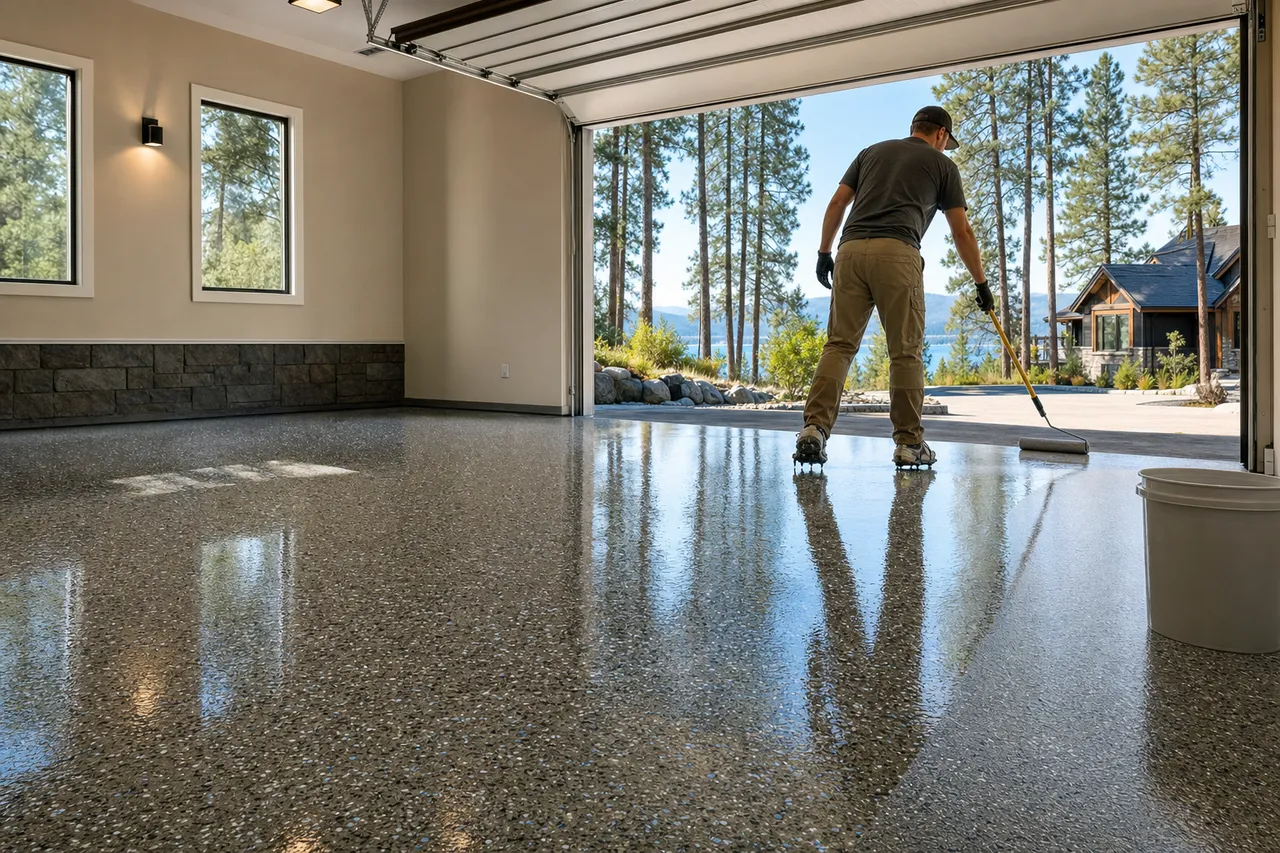
The floor everyone pictures when they say epoxy: dense color flake under a glass-clear top coat, tough enough for a winter of studded tires and easy to hose the road grit off in April. It goes in over ground, metered concrete, and that is the whole difference.
The system
What goes into a garage floor coating in Coeur d'Alene?
A garage floor coating in Coeur d'Alene is built in layers and priced as one number. Each floor gets the full stack: diamond grinding with dust extraction to open the concrete, a moisture reading, crack and spall repair, a penetrating primer, a 100% solids epoxy base, a full-coverage flake broadcast in the blend you pick, and a polyaspartic clear top coat that takes carbide studs, mag chloride and jack stands without complaint.
That stack runs many times the film thickness of a hardware-store kit, and it is the reason the whole floor can be put in a written estimate and stood behind. There is no mystery layer to fail, and no month where the wrong layer was rolled over cold concrete.
- Full flake, solid color, or metallic, with sample chips at the measure
- Cove details, step faces and the apron at the door coated to match
- One-day polyaspartic system when the schedule is tight or the slab is cold
Two days, start to parked
How the install actually goes
Day 0 · The measure
The garage gets walked, the slab gets metered for moisture and temperature, repairs get noted, and you get a written estimate with the system, the prep, and the cure window on it. No deposit until you say go.
Day 1 · Prep
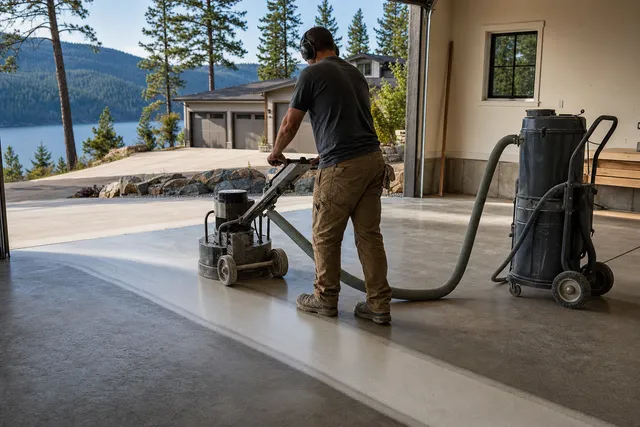
Diamond grind with dust extraction, so the rest of the house stays livable. Cracks cut and filled, spalls by the door patched, edges hand-detailed, the slab vacuumed to bare honest concrete.
Day 2 · Coats
Primer, base coat, flake broadcast to full coverage, a scrape, and the clear top coat. The line at the wall is taped clean. The edge is the signature of a pro floor.
After · The cure
Foot traffic next morning, vehicles after the written cure window. Then it is a floor you clean with a dust mop in summer and a hose nozzle after every thaw.
October to April
What a Coeur d'Alene winter does to a garage floor
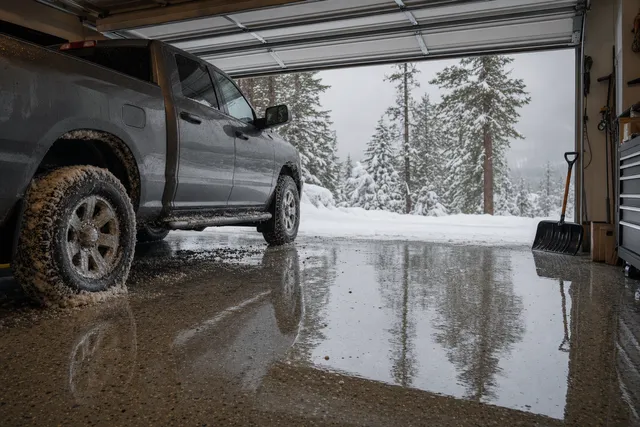
Studded tires are legal in Idaho from October 1 to April 30, and most of the trucks on Highway 95 run them. Every stud carries a little grit in with it and grinds it into the floor while the truck sits. The mag chloride the state sprays on I-90 rides in on the wheel wells and pools under the tires overnight, and the slab underneath all of it is frozen-ground cold from November on. A thin coating loses that fight by February.
A full-thickness system does not. The polyaspartic top coat is the layer built for studs and de-icer; the base coat is bonded into ground concrete, not sitting on it. Hose the slush out when the weather allows and the floor goes a decade or more. The winter guide covers what to rinse, when, and what a peeling spot by the door is actually telling you.
Two-car or three-car? Say which, and the estimate comes back in writing.
Measure the slab, call with the square footage and the year it was poured, and hear a range by system before anyone comes out.
Around the county
Can I get garage floor coating near me in Post Falls, Hayden or Rathdrum?
All three are inside the area, and so is most of the rest of Kootenai County: Hayden Lake, Dalton Gardens, the Prairie subdivisions, Spirit Lake and Athol to the north, and Harrison down the east shore. Wherever the garage is, the installer comes out to it for the measure. A phone call gets a range by system. Which system the floor actually gets is settled on the slab, by its age, how cold it runs and the patch by the door where the de-icer sat all winter.
Already coated once
Recoat, repair, or start over
A lot of Kootenai County garages have a kit coat from a previous owner, or a pro floor that is fifteen years in. Three honest outcomes at the measure: a sound floor with a dull top coat gets a scuff and a new clear coat at $3 - $5 per sq ft per square foot; a floor peeling at the door and the tire tracks gets those areas ground back and patched into a full recoat; a kit floor lifting in sheets gets ground off entirely and coated as new concrete, because nothing bonds to a coating that is not bonded itself.
The tell is a scrape with a putty knife. If the old coating flakes up dry, it was never bonded. If it fights you, there is something to build on.
What a kit floor is telling you
- Peeling in the tire tracks: hot-tire pickup, a thin coat with no top coat
- Bubbles and pinholes: moisture came up through a slab that was never metered
- Lifting in sheets by the door: coated over a de-icer film or a cold slab
- Chalky and dull but stuck: the easy case, a top coat brings it back
Asked around Kootenai County
Garage floor questions, answered with numbers
Will studded tires peel a coated garage floor?
A thin kit coat, yes, usually by the second winter. A ground-in 100% solids base with a polyaspartic or urethane top coat is built for carbide studs and the grit they carry in: the top coat takes the wear, the base holds the concrete. Most Kootenai County trucks run studs from October through April, so every floor here is quoted with that top coat, not as an option.
What does a garage floor coating cost in Coeur d'Alene?
A two-car garage with a full-flake system runs $2,900 - $4,300 installed, a three-car $4,600 - $6,800, roughly $7 - $10 per square foot with prep and the top coat included. Solid-color epoxy runs $5 - $7.50 per square foot. Moisture mitigation on a new or damp slab adds $1.50 - $3 per sq ft, and crack and spall repair after a hard winter is priced as its own line, $150 - $600 on most garages.
How long before I can park on it?
Foot traffic the next morning and vehicles after the cure window written into your estimate, typically 24 to 72 hours for an epoxy system depending on the top coat and the slab temperature. A one-day polyaspartic system is walkable that evening and parked on the next day. Cold slabs stretch epoxy cure times; that is one reason the winter floor here is polyaspartic.
My floor has pitting and a crack by the door. Can it still be coated?
Usually, yes, and the spot by the door is the usual spot: it is where the snowmelt and de-icer sit all winter. Cracks are cut, filled and ground flush, spalls are patched with a polymer repair mortar, and both are priced on the written estimate before the coating goes down. If a slab is heaving or the pitting is through the surface into the aggregate, you will hear that at the measure instead of after.
Which flake colors hold up best here?
Any of them; the flake is vinyl and the top coat is what wears. What matters in a Coeur d'Alene garage is hiding a winter of grit between hose-downs, which favors mid-tone gray, slate and tan blends over solid white or solid black. Physical sample chips come to the measure because a floor looks different under your garage lights than on a screen.
Written estimates, by system
Tell us about the garage. The estimate comes back in writing.
How many bays, the year the slab was poured, and whether it has ever been coated. That is enough to place it in a range, and the measure turns the range into a written number by system. Prefer the phone? Call (208) 758-9728.
- Itemized on paper - the grind, the repairs, the system, the top coat
- Slab moisture and temperature checked before anyone promises a date
- Cold-season work quoted as the system that can actually cure, never a guess